|

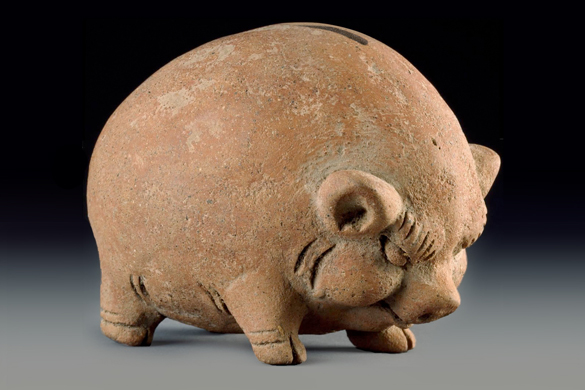
20 February 2013 Today's topic: Form And Function An interesting little fact in an email from my mom led to a lesson about the origins of the "Piggy Bank" and affirmation of the fact that form follows function, usually. Form follows function? The principle is that the shape of an object should be primarily based upon its intended function or purpose. Not so with the Piggy Bank. In medieval England, an orange clay called pygg (pronounced "pug" in Middle English) was used to make a variety of inexpensive household containers, including coin jars. Pygg jars had a small opening or slot to slide coins into and therefore would have to be broken for the coins to be retrieved. The piggy bank in the history of English speaking countries was born from a trick of language, a.k.a. the Great Vowel Shift. Between 1400 and 1700, English vowels came to be formed increasingly higher up and forward in the mouth. This turned the "pug" sound of "pygg" into "pig" and although by the 18th century pygg was no longer the commonly used clay, the name had stuck, thus giving artisans a new design theme in the creation of money boxes for the home.
Piggy Bank East Java, Because the banks had to be destroyed in order to "open" them, a key design element or flaw depending on how you look at it, very few survived. The addition of a removable plug in the 19th century ushered in the era of the collectible piggy bank. So there you have it, a great example of how communication literally defined the shape of things to come.
Digital Imaging, Photo Restoration, Web and Graphic Design in Jarrettsville, MD 21084. Local to Harford, Baltimore, Cecil and Southern York County with limited service worldwide.
|

![[Valid RSS]](valid-rss-rogers.png "Validate my RSS feed")